Scribe IQ



Governed clinical documentation AI prototype. Synthetic longitudinal records, clinical-note-grounded RAG, chart review, structured note generation, and Responsible AI auditability — with provider-agnostic LLM and embedding layers and explicit production boundaries.
Clinical AI is only useful if it is grounded in the patient record, clear about its limits, and auditable when it influences human work. Scribe IQ is built around that premise.
Built on synthetic data. Not for clinical decision-making.
Why this repo exists
Scribe IQ demonstrates how governed institutional data platform patterns translate into healthcare-shaped AI workflows. Built as an architecture review artifact for academic health, research, and education technology environments, it surfaces:
- longitudinal records and sensitive notes as the core data product
- offline corpus construction separated from runtime serving
- retrieval-grounded AI workflows with visible source context
- provider boundary awareness for LLMs and embeddings
- audit-first AI design with redacted previews and prompt/model traceability
- explicit production deltas for PHI, SSO/RBAC, tenancy, BAA-backed deployment, and observability
For role-fit interpretation across healthcare, university, research, and education-IT architecture reviews, see Target role alignment.
What this shows
| Layer | What is demonstrated |
|---|---|
| Corpus / data product | Nine-step offline data_prep/ pipeline over Synthea and public clinical note sources; generated corpus artifact with manifest, dataset card, validation checks, and audit report |
| Serving substrate | FastAPI, Postgres/pgvector, Alembic migrations, async database access, and one governed store for patient rows, notes, embeddings, and audit records |
| Clinical workflows | Patient chart, encounter viewer, care timeline, pre-meeting prep, structured note generation, and grounded RAG chat |
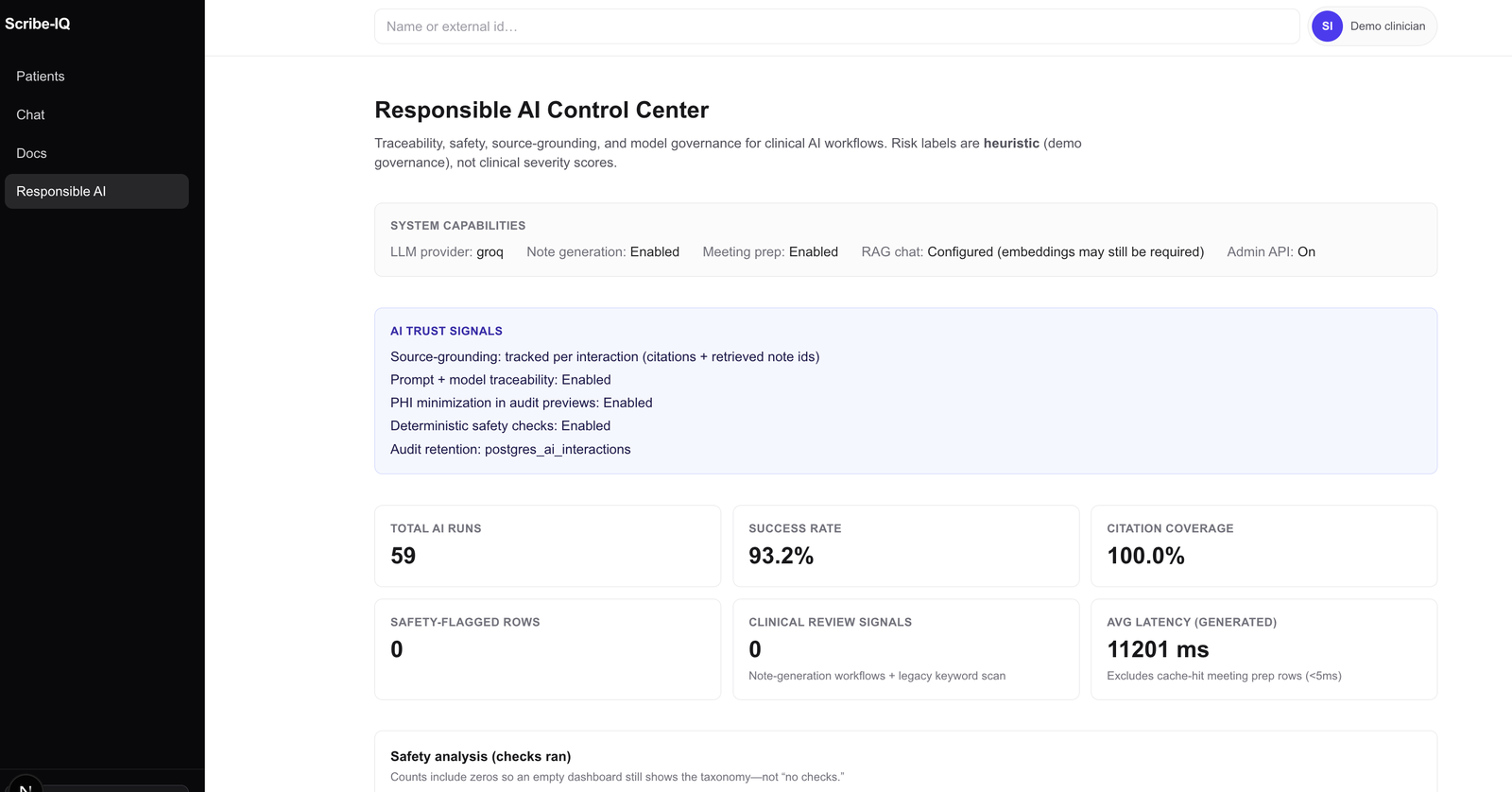
| Responsible AI | Citation contract, append-only ai_interactions, redacted previews, prompt/model traceability, source traces, and Responsible AI Control Center |
Corpus
Scribe IQ runs on a synthetic longitudinal patient and encounter dataset assembled from the following open sources — no real PHI is used:
- Synthea — synthetic patient spine: demographics, encounters, conditions, medications, observations, and longitudinal structure.
- MTSamples — public outpatient-style clinical note examples.
- MedSynth — synthetic SOAP-style clinical notes and dialogue/note pairs.
- ACI-Bench — encounter dialogue examples used in showcase workflows.
data_prep/ matches public note examples to Synthea encounters, scores candidate fit, adapts notes for patient-level consistency, validates outputs, and emits clinical_corpus_v2/ with a manifest, dataset card, and audit report.
Synthetic data only. No real PHI is used. The system is for demonstration and architecture review, not clinical decision-making.
Architecture
data_prep/ → clinical_corpus_v2/ artifact → scribe-load-corpus → Postgres/pgvector → FastAPI → Next.js → ai_interactions audit table.
flowchart TB
  subgraph Offline["Offline corpus pipeline"]
    Raw["Raw synthetic + public sources"] --> Staging["data_prep staging"]
    Staging --> Artifact["clinical_corpus_v2 artifact"]
    Artifact --> Loader["scribe-load-corpus"]
  end

  subgraph Runtime["Runtime app"]
    Next["Next.js UI"] --> API["FastAPI"]
    API --> LLM["LLM provider<br/>Groq · Azure OpenAI · Bedrock"]
    API --> Embed["Embedding provider<br/>OpenAI · Azure OpenAI · Bedrock"]
    API --> Audit["ai_interactions<br/>audit table"]
    Audit --> Admin["Responsible AI Control Center"]
  end

  Loader --> PG[("Postgres + pgvector")]
API --> PGDocumentation
This page mirrors the repository README for the live documentation site.
| Visitor | Best entry point |
|---|---|
| New here | docs/overview/REVIEWER_GUIDE.md |
| Product / architecture reviewer | docs/overview/PORTFOLIO_CASE_STUDY.md |
| Role-fit reviewer | docs/overview/TARGET_ROLE_ALIGNMENT.md |
| Technical reviewer | docs/overview/SYSTEM_OVERVIEW.md |
| Data platform reviewer | docs/guides/CORPUS_ARTIFACTS.md |
| Local setup | docs/guides/QUICKSTART.md |
| Full docs | docs/README.md |
Screenshots
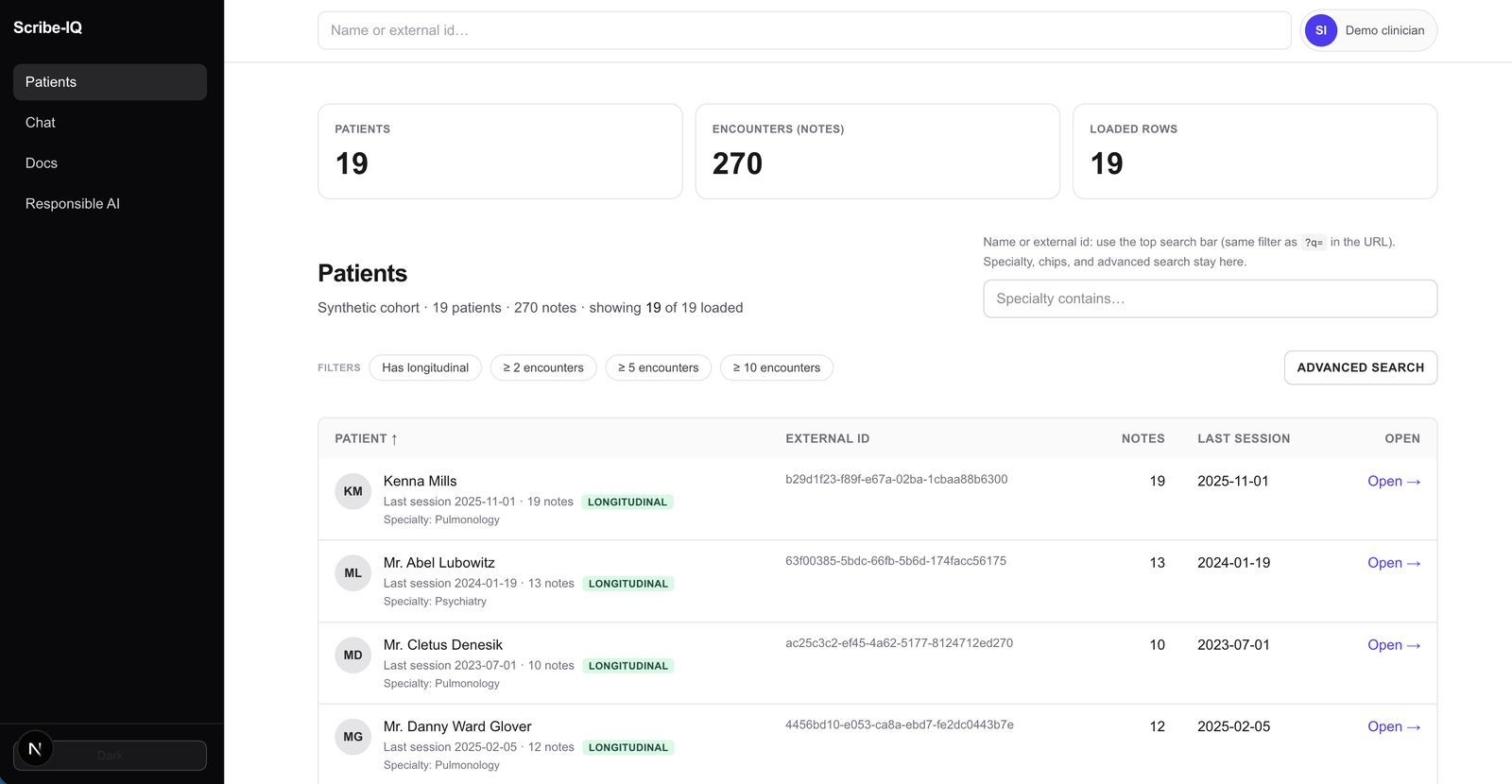
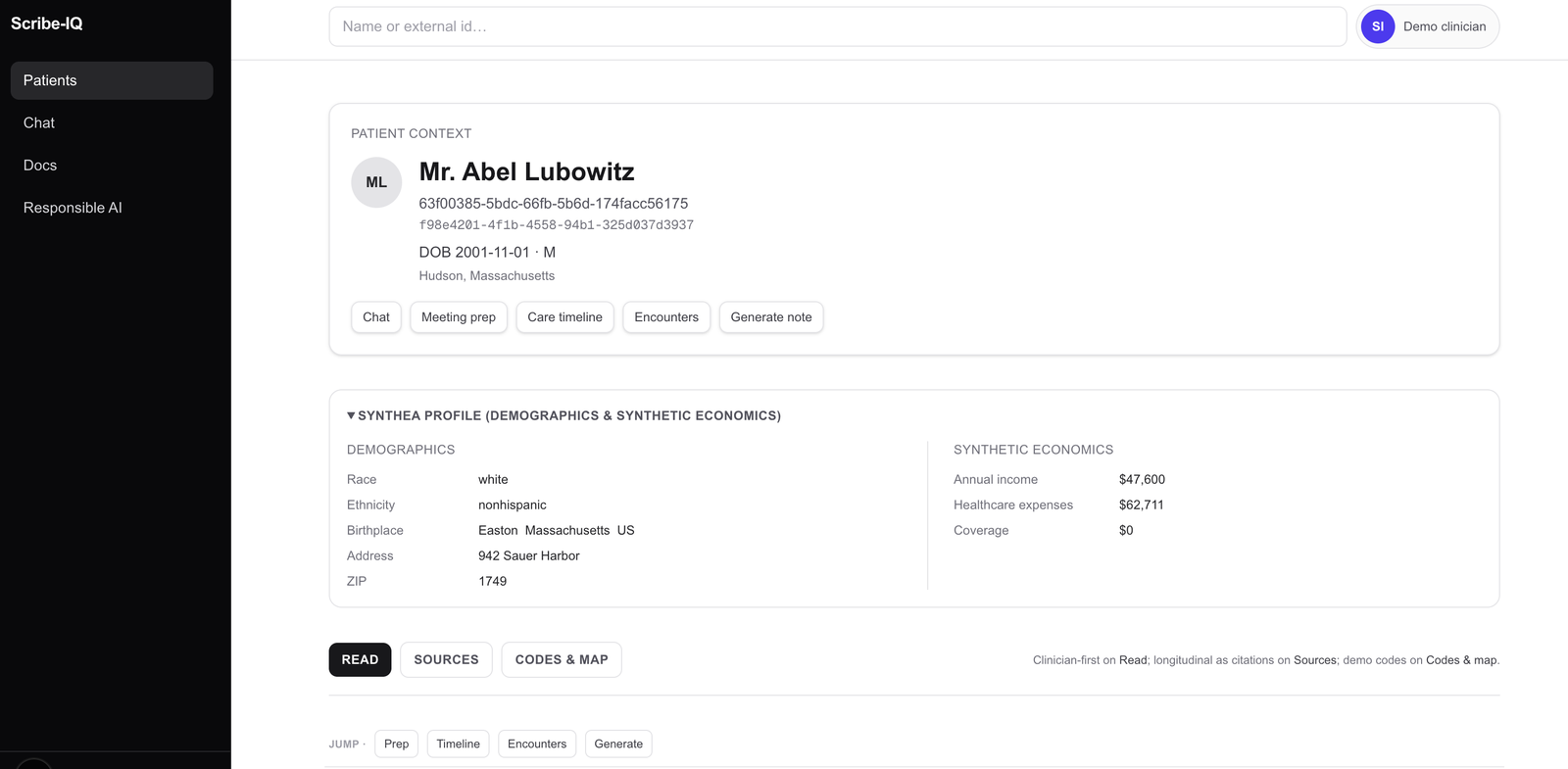
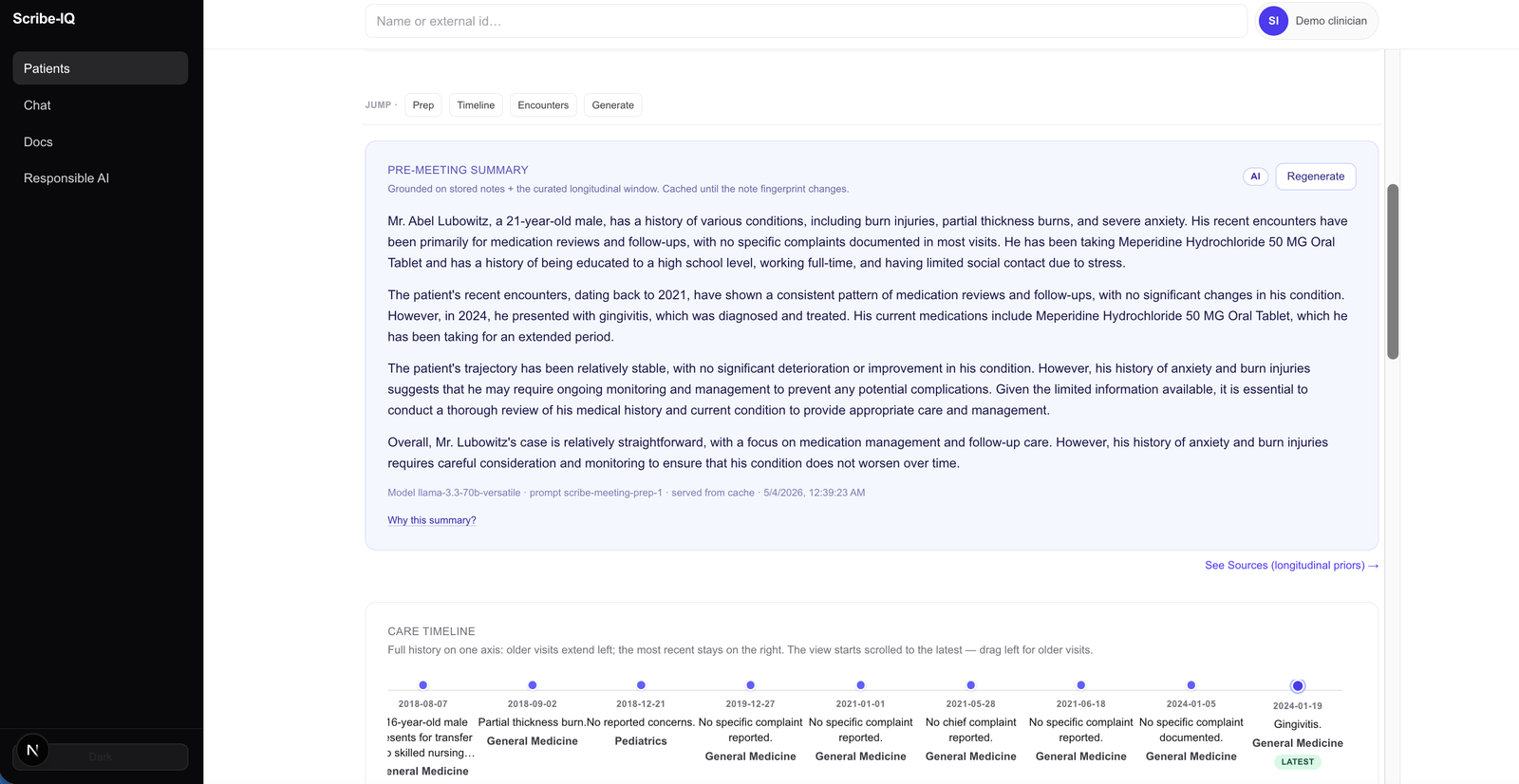
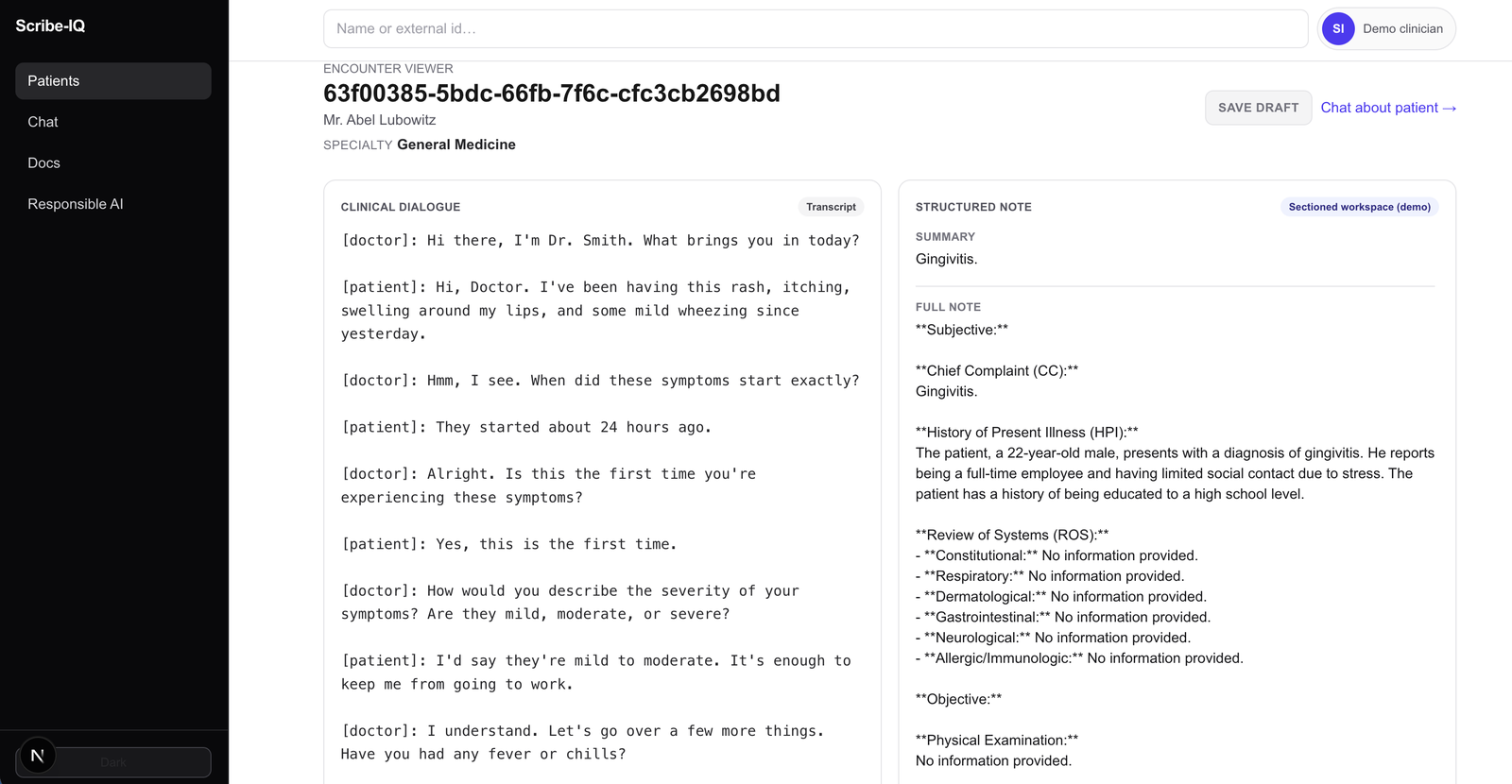
The UI is backed by a synthetic Synthea cohort; on-screen labels make this explicit.
Patient list
Patient chart
Pre-meeting summary
Encounter viewer
Responsible AI
Stack
| Layer | Technology |
|---|---|
| Frontend | Next.js (App Router), TypeScript |
| Backend | FastAPI, asyncpg, Pydantic |
| Data store | Postgres 16 with pgvector |
| LLM | Groq, Azure OpenAI, or Amazon Bedrock |
| Embeddings | OpenAI, Azure OpenAI, or Amazon Bedrock |
| Migrations | Alembic |
| Corpus pipeline | Python, Synthea, MTSamples, MedSynth, ACI-Bench, Hugging Face datasets, Groq |
Feature availability
Every external dependency is optional. The system degrades gracefully and reports what is configured via GET /health.
| Without any keys | LLM provider credentials | Embedding provider credentials + --embed |
Admin flags |
|---|---|---|---|
| Patient list, charts, encounter viewer | Pre-meeting summaries, structured note generation | RAG chat with citations | Responsible AI Control Center |
For the full flag matrix, see docs/overview/SYSTEM_OVERVIEW.md.
Getting started
Local run requires a generated or restored corpus artifact at data/clinical_corpus_v2/. This artifact is produced by the offline data_prep/ pipeline and is not committed as application source. If the directory is empty after clone, see docs/guides/CORPUS_ARTIFACTS.md. Full prerequisites, optional capability paths, and troubleshooting: docs/guides/QUICKSTART.md.
docker compose up -d
cd backend && python -m venv .venv && source .venv/bin/activate && pip install -e .
alembic upgrade head
scribe-load-corpus
uvicorn app.main:app --reload --host 127.0.0.1 --port 8000
# in a second terminal
cd frontend && nvm use && npm install && npm run dev
Frontend: http://localhost:3000. Backend: http://127.0.0.1:8000/health.
Demo readiness
| Area | Status |
|---|---|
| Synthetic clinical corpus pipeline | Implemented |
| Runtime app: charts, encounters, meeting prep, RAG chat, note generation | Implemented |
| Responsible AI audit surfaces | Implemented |
| PHI readiness | Intentionally not claimed |
| SSO / multi-tenant isolation | Deferred production seam |
| Hosted demo URL | Planned / optional |
License
This project is source-available for portfolio review and educational purposes only. Commercial use is prohibited without prior written permission. See LICENSE.