Architecture¶
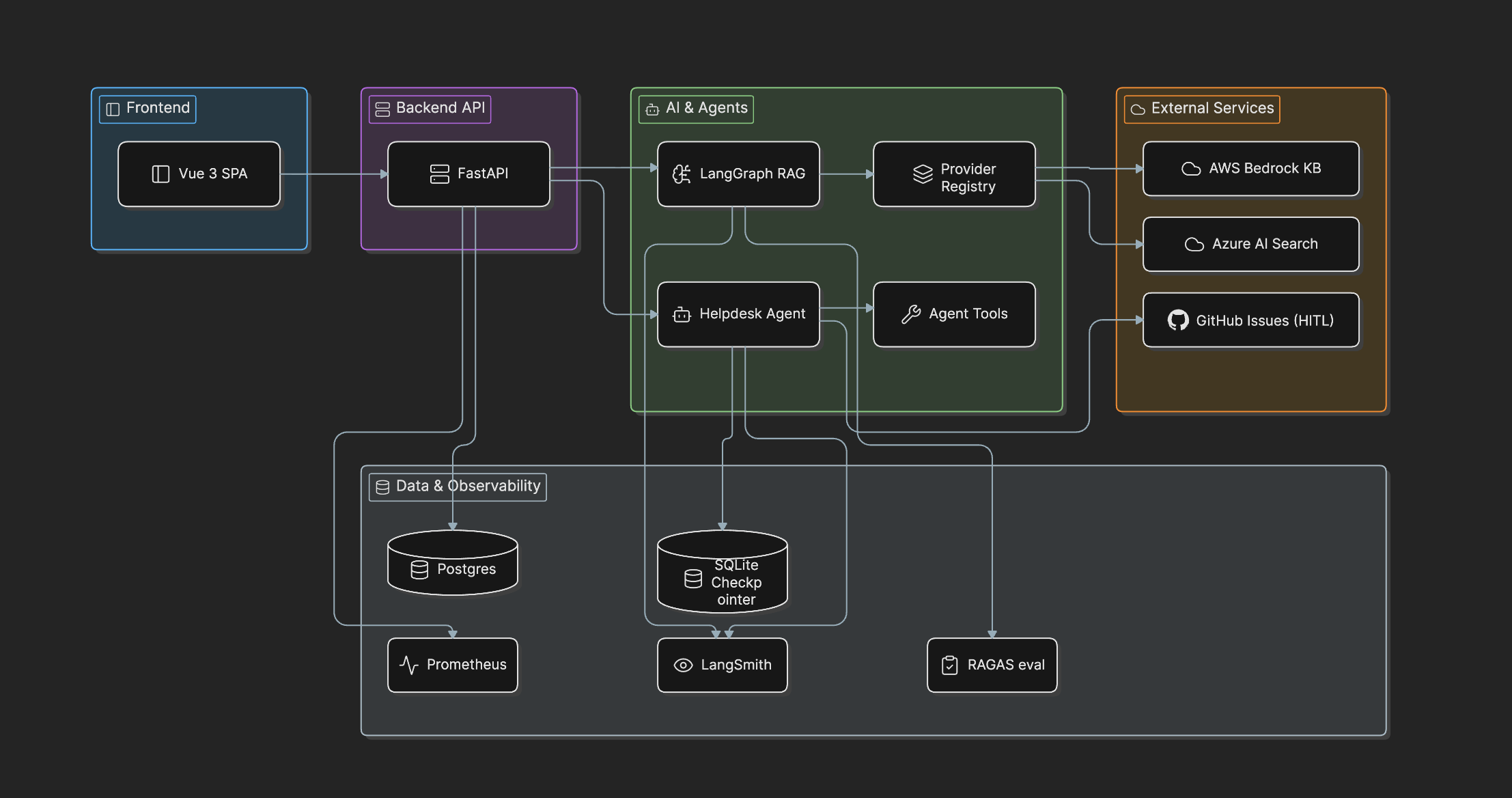
Campus RAG Assistant is a source-reviewable AI platform for governed campus knowledge. It combines a cited-answer RAG path with a HITL-gated helpdesk escalation loop: when the knowledge base cannot resolve a question, the system can retry retrieval, use controlled web research, search GitHub issues for duplicates, draft a ticket, and file to GitHub only after human confirmation. The system runs behind one FastAPI backend and Vue 3 SPA with AWS / Azure / GCP / mock providers, RAGAS evaluation, LangSmith and Prometheus observability, CI/security gates, redaction, and responsible-AI guardrails.
This page describes the current system architecture first, then keeps earlier versions as collapsed drill-downs so reviewers can understand the evolution without reconstructing the live architecture from release history.
For design goals and decision rationale, see DESIGN.md. For release-by-release summaries, see release-notes/.
Current architecture¶
| Layer | Current shape |
|---|---|
| Client | Vue 3 SPA is primary; Streamlit remains an optional client on the same REST API |
| API | FastAPI under /api/auth, /api/chat, and /api/helpdesk; JWT auth in HTTP-only cookies; SSE for chat and agent status streams |
| RAG orchestration | RAG_ENGINE=chain for token streaming and CI default; RAG_ENGINE=langgraph for explicit condense -> multi_query -> retrieve -> rerank -> generate -> format graph nodes |
| Providers | Pluggable LLM and retriever registry: AWS, Azure, GCP, or mock via LLM_PROVIDER, RETRIEVER_PROVIDER, and RAG_FORCE_MOCK |
| AWS retrieval | Bedrock Knowledge Base retrieve API backed by OpenSearch Serverless; the app does not call OpenSearch directly |
| Azure retrieval | Azure AI Search fills the same retriever contract for vector / hybrid search |
| GCP retrieval | Vertex AI Search (Discovery Engine) managed datastore via VertexAISearchRetriever |
| Helpdesk agent | Bounded multi-turn AGENT mode with retry-KB, web search, duplicate-issue search, draft-ticket, HITL confirm, four terminal outcomes, redaction, and Prometheus metrics |
| Persistence | PostgreSQL + Alembic for application data; helpdesk agent checkpoints currently use SQLite keyed by chat session |
| Observability and quality | LangSmith traces, Prometheus metrics, RAGAS baseline checks, k6 load validation, and CI mock-provider coverage |
Primary request paths¶
- Ask mode: Vue sends
POST /api/chat/stream; FastAPI runs the configured RAG path, streams answer tokens/status, persists the message, and returns source metadata for the citation panel. - Agent mode: When RAG is unresolved, Vue can start
/api/helpdesk/agent/start/stream; the backend runs a bounded helpdesk loop, pauses for clarifying input when needed, and requires/agent/confirmbefore filing a GitHub issue. - Operations path: Health, metrics, release, CI/CD, security, and load-testing runbooks live in the Operations Manual.
Overview diagram¶
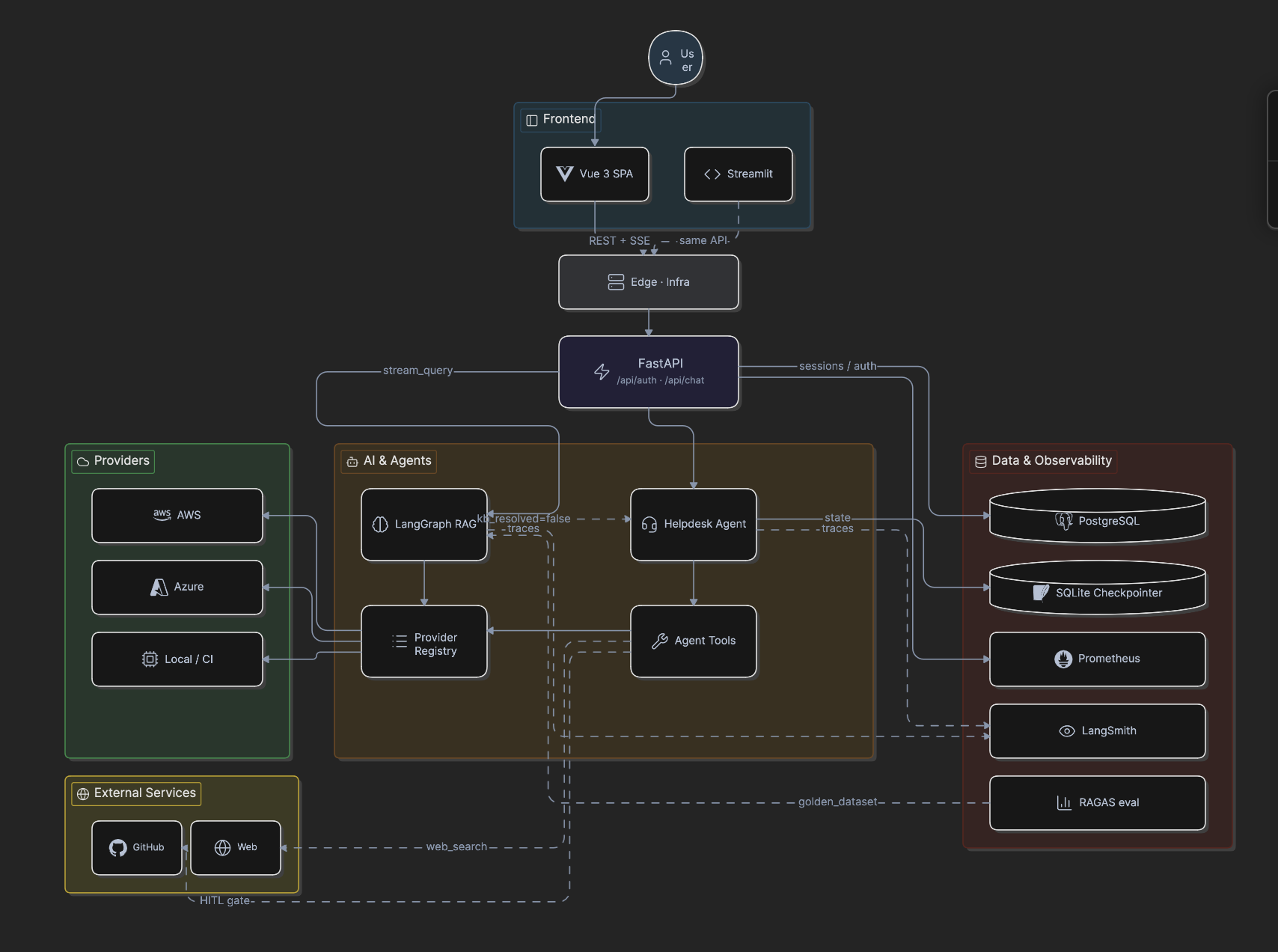
Detailed diagram¶
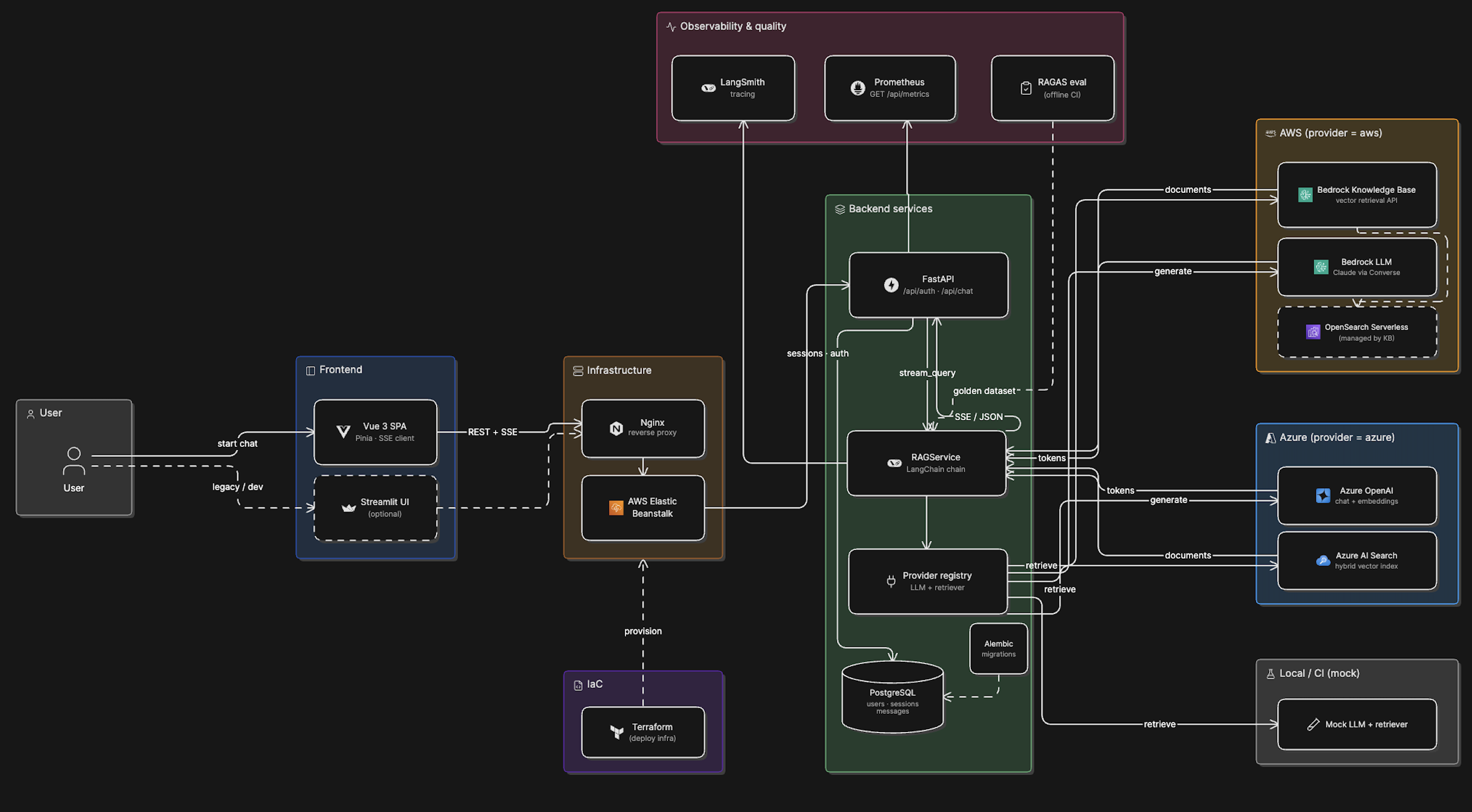
Full topology¶
RAG pipeline subgraph (condense -> multi_query -> retrieve -> rerank -> generate -> format) plus helpdesk agent subgraph (supervisor -> specialists -> tools -> HITL gate):
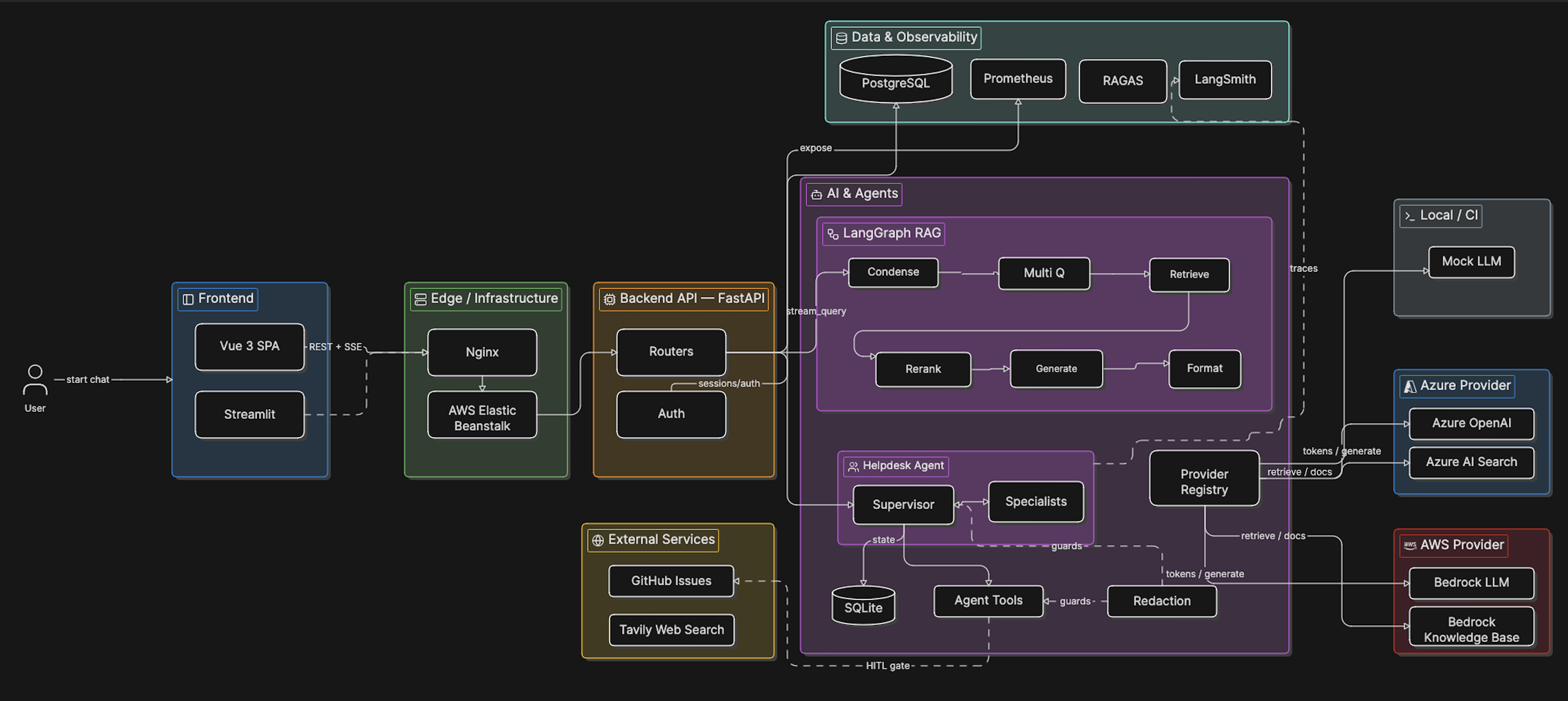
The topology image is the reviewer map for the whole current architecture: the RAG path, helpdesk agent path, external services, persistence, and observability surfaces are shown together before historical versions.
Evolution from v2 (RAG platform)
v2 introduced the Vue SPA, provider registry, LangGraph RAG pipeline, RAGAS eval, and GitHub Actions CI/CD. v3 keeps that platform and adds a bounded helpdesk agent.
| Area | v2 (RAG platform) | v3 (+ helpdesk agent) |
|---|---|---|
| UI | Vue 3 SPA with KB chat, sources, web toggle | Ask / Agent mode switch, agent activity timeline, ticket review modal |
| API | /api/chat/*, /api/helpdesk/{summarize,draft-ticket,create-issue} |
/api/helpdesk/agent/* — start, resume, confirm, abort + SSE streams |
| Orchestration | LangGraph RAG only | RAG + helpdesk LangGraph (supervisor, specialists, tools) |
| Checkpointing | — | SQLite checkpointer (Postgres planned — AGENTIC_HELPDESK_REBUILD) |
| External actions | — | GitHub Issues (HITL-gated), Tavily web search |
| Observability | LangSmith + Prometheus | + chatbot_helpdesk_agent_* metrics, agent funnel counters |
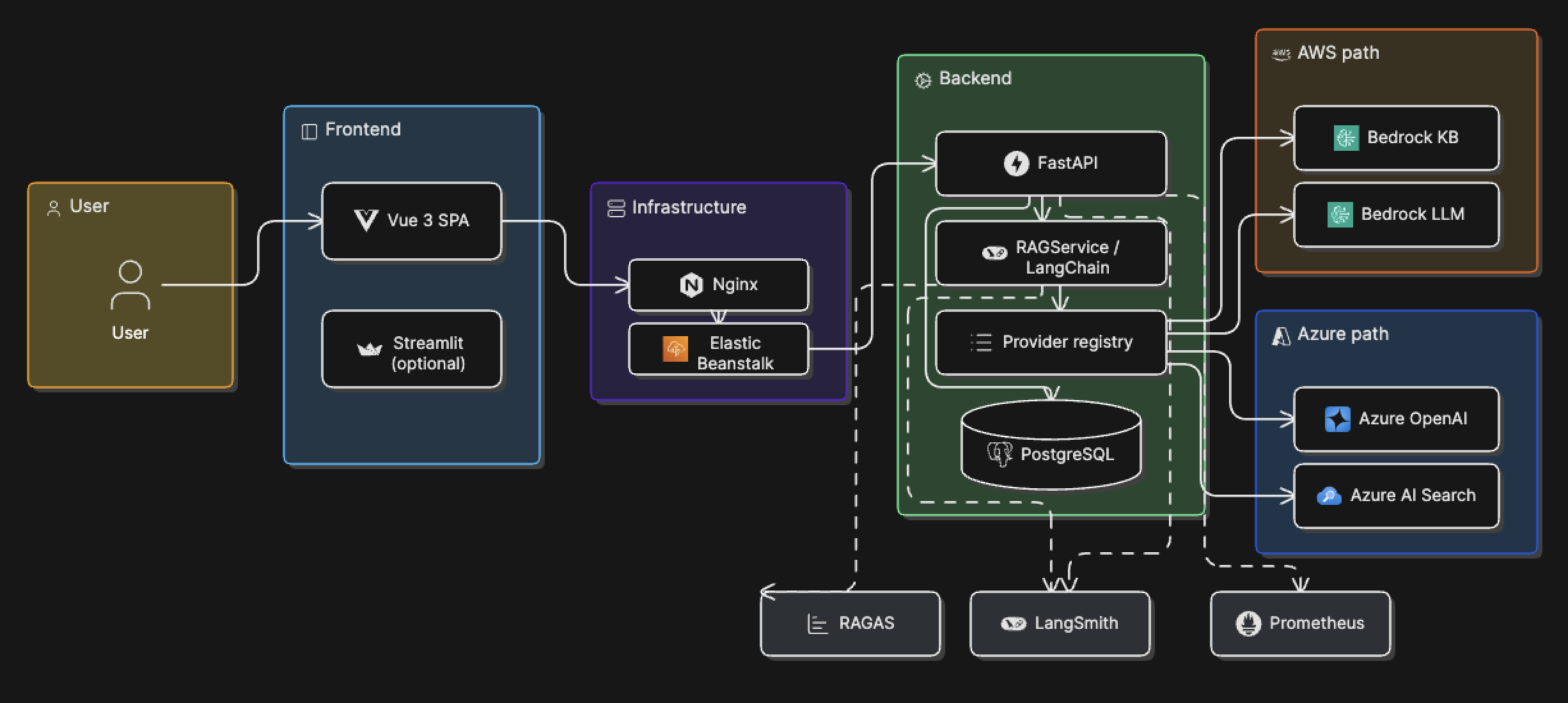
Detailed (v2)¶
| Asset | Description |
|---|---|
architecture/v2/overview.png |
v2 high-level overview |
architecture/v2/detailed.png |
v2 component detail |
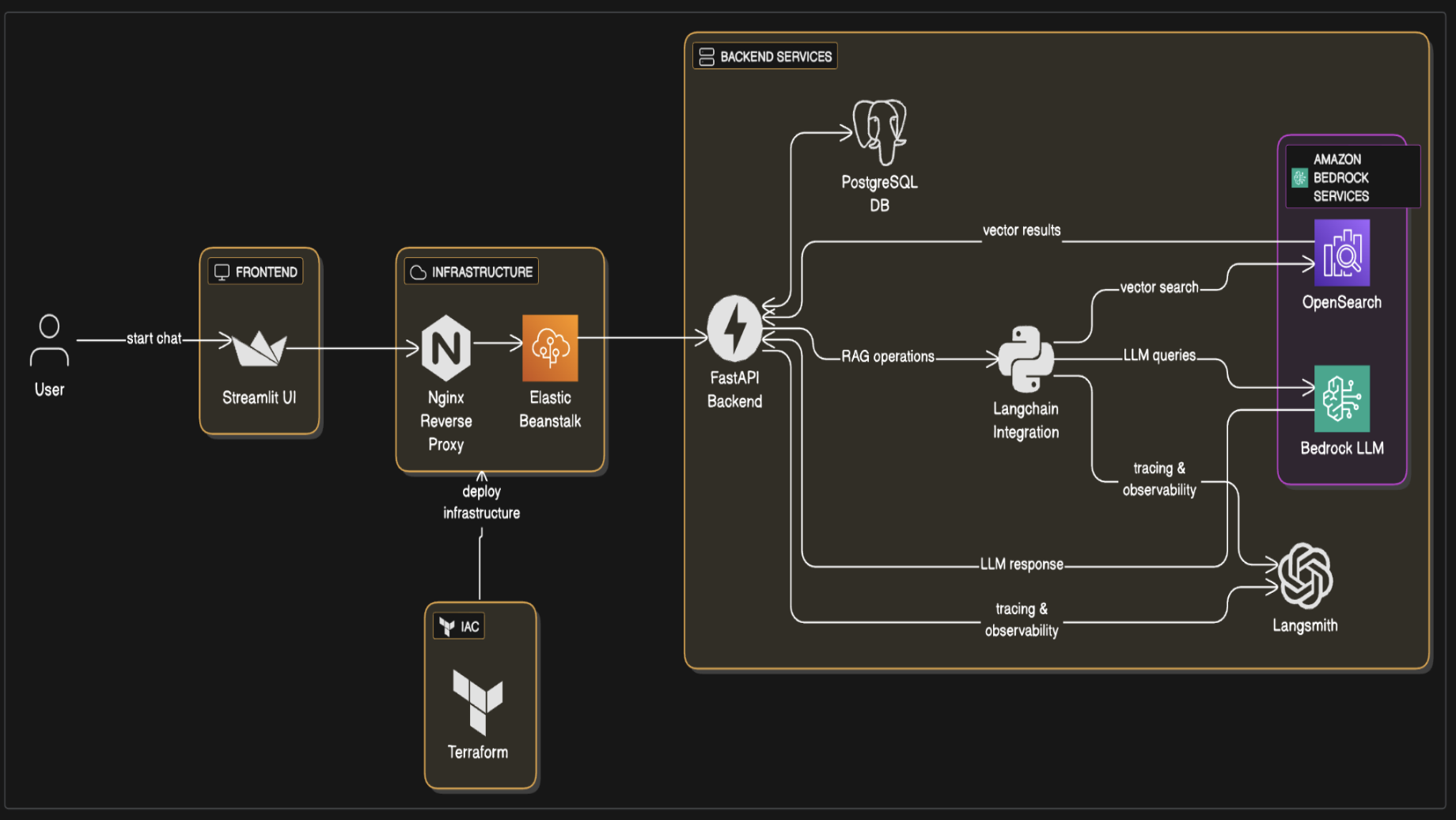
Upstream baseline (v1)
Original upstream ets-berkeley-edu/chabot architecture (Streamlit-only UI, LangChain → OpenSearch + Bedrock directly):
| Area | Upstream chabot (v1) | Campus RAG Assistant (v2+) |
|---|---|---|
| UI | Streamlit only | Vue 3 SPA (primary); Streamlit optional, same API |
| API | Chat endpoints | SSE POST /api/chat/stream, sessions CRUD, feedback, sources |
| Auth | — | JWT in HTTP-only cookies (/api/auth/*) |
| Retrieval (AWS) | LangChain → OpenSearch directly | Bedrock Knowledge Base API; OpenSearch Serverless behind the KB |
| Retrieval (Azure) | — | Azure AI Search vector + keyword/hybrid index |
| Retrieval (GCP) | — | Vertex AI Search managed datastore (Discovery Engine) |
| LLM | Bedrock only | Bedrock, Azure OpenAI, Vertex AI Gemini, or mock via LLM_PROVIDER |
| DB | PostgreSQL | PostgreSQL + Alembic |
| Ops | LangSmith | LangSmith + Prometheus — OPERATIONS.md — Shipped performance guardrails |
| Quality | — | RAGAS harness, k6 load tests |
Chat request flow¶
sequenceDiagram
  participant UI as Vue SPA
  participant API as FastAPI /api/chat
  participant RAG as RAGService
  participant Graph as LangGraph (optional)
  participant KB as Provider retriever

  UI->>API: POST /stream (SSE) + research_mode
  API->>RAG: stream_query / query + history
  alt RAG_ENGINE=langgraph
    RAG->>Graph: condense / multi_query / retrieve / rerank
    Graph->>KB: retrieve (KB path)
    KB-->>Graph: documents + metadata
    Graph-->>RAG: answer + sources
  else RAG_ENGINE=chain
    RAG->>KB: retrieve context
    KB-->>RAG: documents + metadata
  end
  RAG-->>API: tokens + sources (+ source_kind)
  API-->>UI: SSE status/token/done
UI->>UI: normalize markdown, render + sources panel- Streaming (preferred):
POST /api/chat/streamemits Server-Sent Events (token, thendonewith sources). The Vue store appends tokens live, then persists the final message. - Buffered fallback:
POST /api/chat/chatreturns the full assistant message when streaming fails or is disabled. - Sessions: Messages belong to a
ChatSessionper user; history is passed into the LangChain conversational chain for follow-up questions. - Answer shape: The model is instructed via
backend/app/templates/prompt_prefix.txtto use a consistent Markdown template (summary →##sections → bold lead-ins → bullets / numbered steps). Backend and frontend apply light sanitization only (drop prompt leakage, optional**Title**→## Title); they do not rewrite structure with topic-specific heuristics.
Helpdesk capabilities (post-RAG)¶
The shipped ASK-mode escalation path offers one-shot recap, draft, and
GitHub issue creation when RAG marks a response unresolved. Vue also exposes
an opt-in AGENT mode on top of the HELPDESK_AGENT_ENABLED backend, rendering
each multi-turn helpdesk journey as one assistant bubble with an activity timeline.
Product spec: CONVERSATION_FLOW.md. Agent
engineering spec: HELPDESK_AGENT.md.
Endpoint surface¶
| Endpoint | Purpose | Available in |
|---|---|---|
POST /api/helpdesk/summarize |
Narrative conversation recap (utility, no side effects) | ASK escalation |
POST /api/helpdesk/draft-ticket |
One-shot structured ticket draft (no agent loop) | ASK escalation / legacy modal fallback |
POST /api/helpdesk/create-issue |
File reviewed draft on GitHub (idempotent, HITL-gated) | ASK escalation / legacy modal fallback |
POST /api/helpdesk/agent/start |
Start multi-turn helpdesk agent session | AGENT mode |
POST /api/helpdesk/agent/start/stream |
SSE status stream for start, ending with AgentTurn |
AGENT mode preferred path |
POST /api/helpdesk/agent/resume |
Resume paused agent with the user's reply | AGENT mode |
POST /api/helpdesk/agent/resume/stream |
SSE status stream for resume, ending with AgentTurn |
AGENT mode preferred path |
POST /api/helpdesk/agent/confirm |
User confirms draft -> internal call to create-issue |
AGENT mode |
POST /api/helpdesk/agent/abort |
Cancel an in-flight agent session | AGENT mode |
kb_resolved heuristic¶
When the KB path cannot resolve a question, the API sets
metadata.kb_resolved=false on the assistant message (fuzzy match against
the hydrated out-of-scope message, optional rerank score floor). The Vue
chat UI uses this signal to surface escalation chips on the last assistant
reply; AGENT mode swaps those actions for Get help and continues the journey inline.
Backend agent flow¶
sequenceDiagram
    participant User
    participant Vue
    participant ChatAPI as POST /api/chat/stream
    participant RAG as LangGraph (RAG)
    participant Help as /api/helpdesk/*
    participant Agent as Helpdesk LangGraph
    participant GH as GitHub API

    User->>Vue: question
    Vue->>ChatAPI: stream
    ChatAPI->>RAG: run_rag_graph
    RAG-->>ChatAPI: answer + kb_resolved
    ChatAPI-->>Vue: SSE done
    alt Summarize chip
        ChatAPI->>Help: POST /summarize
        Help-->>Vue: ConversationSummary
    end
    alt Create ticket chip
        ChatAPI->>Help: POST /draft-ticket
        Help-->>Vue: TicketDraft
        User->>Vue: review + submit (modal)
        Vue->>Help: POST /create-issue
        Help->>GH: POST /repos/{demo}/issues
    end
    alt AGENT mode starts backend flow
        Vue->>Agent: POST /agent/start/stream
        loop supervisor loop (bounded)
            Agent->>Agent: pick next_action
            Agent->>Agent: tool call (retry_kb / web_search / search_dups)
            opt agent asks
                Agent-->>Vue: AgentTurn(question, choices)
                User->>Vue: reply
                Vue->>Agent: POST /agent/resume/stream
            end
        end
        Agent-->>Vue: AgentTurn(draft_ready | linked | resolved | aborted)
        opt draft_ready
            User->>Vue: review + confirm
            Vue->>Agent: POST /agent/confirm
            Agent->>GH: POST /repos/{demo}/issues (HITL gate)
        end
endProperties¶
- HITL gate: the agent never files an issue without an explicit user
"File it" confirmation. The
file_tickettool is reachable only through/agent/confirm. - Multi-turn state: agent sessions persist via LangGraph
SqliteSaverkeyed by chatsession_id. Checkpoints TTL'd after 24h. - Defense in depth: redaction applied on every LLM input and again immediately before posting to GitHub.
- Bounded budgets: hard caps on supervisor steps, clarifying questions, KB retries, web searches, duplicate searches, per-session tokens, and per-user-per-day sessions. See HELPDESK_AGENT.md.
- Mock-mode parity: with
provider.is_mock, the supervisor follows a deterministic scripted plan tied to the sentinel queryOracle Financials 403 error on budget reportsso the full agent flow is demo-able without AWS or GitHub credentials. - Frontend state: Vue stores one in-memory/persisted bubble per
agent_session_id; streamed status updates drive the typing indicator and finalAgentTurnupdates the same card. - Scope: Vue frontend only (Streamlit unchanged).
- Secrets:
GITHUB_TOKEN+GITHUB_REPO(private demo repo); see.env.exampleand SECURITY.md.
AWS retrieval: Bedrock Knowledge Base and OpenSearch¶
On AWS, the application calls the Bedrock Knowledge Base retrieve API via LangChain's AmazonKnowledgeBasesRetriever — not OpenSearch HTTP endpoints directly. In a typical deployment:
App (AmazonKnowledgeBasesRetriever)
  → Bedrock Knowledge Base (retrieve, metadata filters)
    → OpenSearch Serverless (vector index + chunk storage)
| Component | Role |
|---|---|
| Bedrock Knowledge Base | Managed RAG entry point: sync connectors, chunking, retrieve API, citation metadata |
| OpenSearch Serverless | Vector (and often hybrid) index backing the KB; ingestion and index lifecycle owned by AWS |
| ServiceNow / LMS corpus | Source content ingested into the KB (e.g. knowledge articles synced to the index) |
The application owns one retriever interface in the provider registry — RETRIEVER_PROVIDER=aws selects the KB path with optional metadata filters via build_bedrock_vector_filter in backend/app/services/retrieval.py. Index lifecycle, chunking, and ingestion connectors stay managed by AWS, so the app does not run OpenSearch client code.
Azure retrieval: Azure AI Search¶
On Azure, the application owns the retrieval call directly: it computes the query embedding with AzureOpenAIEmbeddings and calls Azure AI Search via the azure-search-documents SearchClient. There is no managed retrieval API like Bedrock Knowledge Base in this path.
App (AzureHybridRetriever)
  -> AzureOpenAIEmbeddings (query vector)
  -> Azure AI Search (hybrid: vector_queries + search_text/BM25)
| Component | Role |
|---|---|
| Azure AI Search index | Vector + keyword index storing chunked content; text_vector carries embeddings while textual fields support BM25 matching |
| AzureOpenAIEmbeddings | App calls the Azure OpenAI embedding deployment to vectorize the user query at retrieval time |
| AzureHybridRetriever | App-owned LangChain retriever that issues one hybrid search and yields Document objects with kb_* citation metadata (backend/app/services/providers/retriever/azure.py) |
| Azure OpenAI chat deployment | LLM provider when LLM_PROVIDER=azure, configured separately from the embedding deployment |
RETRIEVER_PROVIDER=azure selects AzureHybridRetriever. Unlike the AWS path, ingestion, chunking, and index lifecycle are not abstracted by a managed retrieval API; the app issues the hybrid search and the index is populated and refreshed outside the app process.
GCP retrieval: Vertex AI Search¶
On GCP, the managed retrieval path mirrors AWS Bedrock Knowledge Base: Vertex AI Search (Discovery Engine) owns ingestion, chunking, embedding, and hybrid retrieval. The app wraps VertexAISearchRetriever from langchain-google-community and normalizes result metadata to the shared kb_* citation schema.
App (GcpSearchRetriever)
  -> VertexAISearchRetriever (Discovery Engine search API)
  -> metadata normalization (kb_url, kb_number, score, ...)
| Component | Role |
|---|---|
| Vertex AI Search datastore | Managed corpus: connectors, chunking, embeddings, and hybrid search |
| VertexAISearchRetriever | LangChain retriever calling the Discovery Engine API (backend/app/services/providers/retriever/gcp.py) |
| GcpSearchRetriever | Thin wrapper mapping Vertex result metadata to app citation fields |
| Vertex AI Gemini | LLM provider when LLM_PROVIDER=gcp via ChatGoogleGenerativeAI (Vertex backend) |
RETRIEVER_PROVIDER=gcp selects GcpSearchRetriever. Auth uses Application Default Credentials or GOOGLE_APPLICATION_CREDENTIALS; configure GCP_PROJECT_ID, VERTEX_SEARCH_DATA_STORE_ID, and related vars in .env.example §6b.
Backend¶
- Entry:
backend/app/main.pybuilds the FastAPI app; runs SQLAlchemycreate_allonly in dev/test (production uses Alembic); configures CORS, and mounts routers under/api/authand/api/chat. - Configuration: Pydantic settings in
backend/app/config/default.py, loaded viabackend/app/core/config_manager.pyfrom layered.envfiles (APP_ENV, repo root.env,.env.{APP_ENV}). - Auth: JWT plus HTTP-only cookies (
/api/auth/login-json, register, OAuth via/api/auth/oauth/{provider}/…; dev uses API-port callback (OAUTH_REDIRECT_BASE_URLon:8000) and one-time redirect to Vue/oauth/handoff— OPERATIONS.md — OAuth and authentication. CookieSecureandSameSitefollowAUTH_COOKIE_*settings (see.env.example, OPERATIONS.md — Production HTTPS). - RAG:
backend/app/services/rag.py—RAG_ENGINE=chain(default in tests via conftest) uses a LangChain conversational retrieval chain;RAG_ENGINE=langgraphrunsbackend/app/services/graph/with KB path condense → multi_query → retrieve → rerank → generate → format (web path skips rerank; see DESIGN.md — LangGraph KB path and Opt-in web research). - LangGraph streaming: When
RAG_ENGINE=langgraph,/api/chat/streamemits astatusevent, runs the graph in a worker thread, then streams the buffered answer in paced chunks (not token-level Bedrock streaming). UseRAG_ENGINE=chainforastream_eventsTTFT. - Research mode: Optional
research_mode=webon chat requests whenWEB_RESEARCH_ENABLED=true; responses includesource_kindand a web disclaimer when applicable. - Singleton:
get_rag_service()returns one sharedRAGServiceinstance (thread-safe) for all chat handlers. - Providers:
backend/app/services/providers/registers LLM and retriever implementations (aws,azure,gcp,mock) selected byLLM_PROVIDER,RETRIEVER_PROVIDER, optionalRAG_PROVIDER, andRAG_FORCE_MOCK. When bothLLM_PROVIDERandRETRIEVER_PROVIDERare set, they take precedence overRAG_PROVIDER.
Chat API surface (summary)¶
| Endpoint | Purpose |
|---|---|
POST /api/chat/stream |
SSE streaming reply |
POST /api/chat/chat |
Buffered reply |
GET/POST/DELETE /api/chat/sessions |
Conversation CRUD |
POST /api/chat/feedback |
Thumbs up/down |
GET /api/auth/oauth/{provider}/start |
OAuth redirect (e.g. github) |
GET /api/auth/oauth/{provider}/callback |
OAuth callback on API origin; dev handoff to Vue /oauth/handoff |
GET /api/chat/messages/{id}/sources |
Source metadata for a message |
POST /api/helpdesk/summarize |
Narrative conversation recap from the last N chat turns (auth + rate limit) |
POST /api/helpdesk/draft-ticket |
Structured ticket draft from the last N chat turns (auth + rate limit) |
POST /api/helpdesk/create-issue |
File reviewed draft to GitHub (idempotent, demo repo) |
Frontend (frontend-vue/)¶
- Data flow: Axios client (
src/api/) → Pinia stores (src/stores/) → views/components. Cookies sent withwithCredentials. - Chat UI:
ChatView+ sidebar session list;MessageBubble(Markdown, user/assistant lanes, accessible accent);SourcesPanel/SourcesSummarybelow assistant replies;MessageFeedback; SSE streaming with typing/status indicator. Dev server:http://127.0.0.1:5173. - Routing: Vue Router guards call
fetchCurrentUserfor protected routes. - Testing: Vitest + MSW (
src/mocks/) for unit/integration tests; Playwright undere2e/(see OPERATIONS.md — Playwright E2E).
Production-oriented behavior¶
When APP_ENV is production or prod (configurable via .env):
ENABLE_DEV_API_ROUTESdefaults to false (hides/api/auth/debug-auth,/api/chat/test_langsmith).ENABLE_OPENAPI_DOCSdefaults to false (no Swagger/ReDoc/OpenAPI JSON).AUTH_COOKIE_SECUREdefaults to true.
Override any of these explicitly in .env when needed.
CORS¶
- If
BACKEND_CORS_ORIGINSis*, the app allows a fixed list of local origins plusFRONTEND_URL. - For production, set
BACKEND_CORS_ORIGINSto an explicit comma-separated list of allowed origins (see.env.example).
Rate limiting¶
backend/app/core/rate_limit.py— process-local sliding windows on auth/chat (RATE_LIMIT_ENABLED). Use Redis-backed limits for multi-instance production.
Testing note¶
Integration tests mock RAG by patching backend.app.api.chat.get_rag_service (the name bound in the chat router module), not only backend.app.services.rag.get_rag_service, because the router imports that function by reference at load time.